
Electrical Panel Upgrades
What you need to know before adding a heat pump, EV charger or other electric equipment. A plain-language guide for Canadian homeowners.
The short version
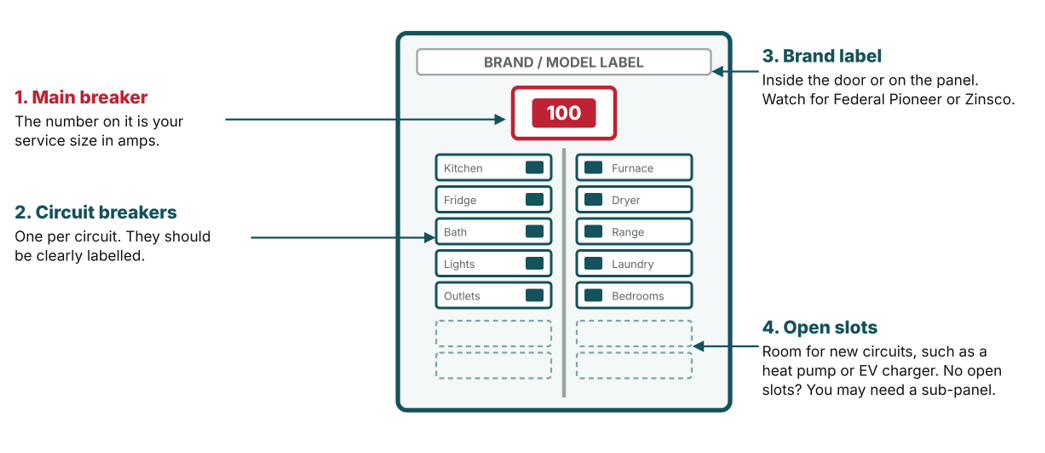
1. Check your panel first. Note the number on the main breaker (your amps) and the panel brand.
2. Get a load calculation before you upgrade. You may not need a bigger service at all.
3. Plan for the next 10 to 20 years. Heat pump, EV charger, electric cooking: do the work once
4. Allow time. The utility’s part of the job can take weeks.
Learn Before You Electrify
1 – How Your Home’s Electrical Service Works
Electricity comes from the utility line, through your meter, into your electrical panel, and out to every circuit in your home. The utility owns everything up to the meter. Everything from the meter inward is yours to maintain and upgrade.
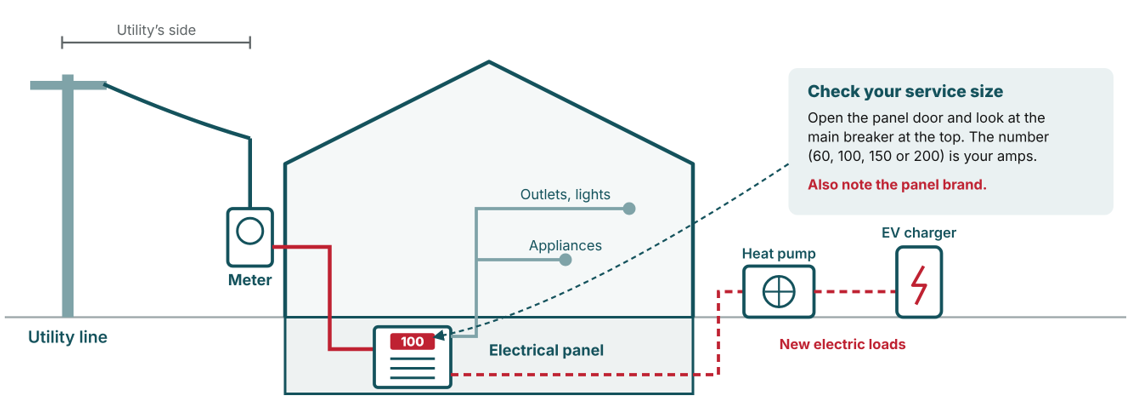
Think of it like a water pipe: a bigger service (more amps) can carry more electricity to more appliances at the same time. An upgrade widens the pipe.
|
Service size |
Typical in homes built |
What it supports |
|
60 amps |
Before 1950 |
Lights and small appliances only. Upgrade is overdue for any electric heating or EV charging. |
|
100 amps |
1950s to 1980s |
Fine for a gas-heated home. Often limiting once you add a heat pump, EV charger or electric cooking. |
|
150 amps |
1970s onward |
Better, but may still be tight for a fully electric home. |
|
200 amps |
Today’s standard |
Enough for most homes with a heat pump, EV charger and electric cooking. |
2 – Do You Actually Need an Upgrade?
Reading your panel
Not always. Many homes can add a heat pump or EV charger without a bigger service. Signs you may need one:
A load calculation is not optional
Any upgrade should be based on a load calculation under the Canadian Electrical Code, not a guess. It adds up your home’s electrical loads and shows whether your current service is enough. Ask every electrician: “Will you do a load calculation, and can I see it?”
An Energy Advisor can help you avoid an upgrade
Air sealing and insulation can mean a smaller heat pump, which uses less power and may fit within your existing service. A registered Energy Advisor can look at the whole home, help plan your electrification in the right order, and help you avoid paying for capacity you do not need.
3 – Is Your Panel Safe?
Some older panels should be checked or replaced for safety, whatever your capacity needs.
|
Panel type |
What to know |
|
Federal Pioneer (Stab-Lok breakers) |
Common from the 1950s to 1980s. Some breakers may not trip during an overload. Many electricians and insurers recommend replacement. |
|
Zinsco / GTE-Sylvania |
Breakers can fuse to the panel and fail to trip. Replacement is recommended. |
|
Fuse box |
Found in older homes. Wrong-size fuses are a common fire risk. A modern breaker panel is strongly recommended. |
|
Split-bus panel |
No single main breaker; parts are hard to find. Usually replaced during any upgrade. |
|
Modern panel (e.g. Siemens, Square D, Eaton) |
Safe and reliable. May still need more amps, but not replacement for safety alone. |
Two more things to check
Aluminum wiring: some homes built around 1965 to 1975 have aluminum wiring in the walls. It needs special connections and care. Tell your electrician before work starts.
Insurance: if you have one of the panels above, call your insurer. Some charge more or require replacement.
4 – Alternatives to a Full Upgrade
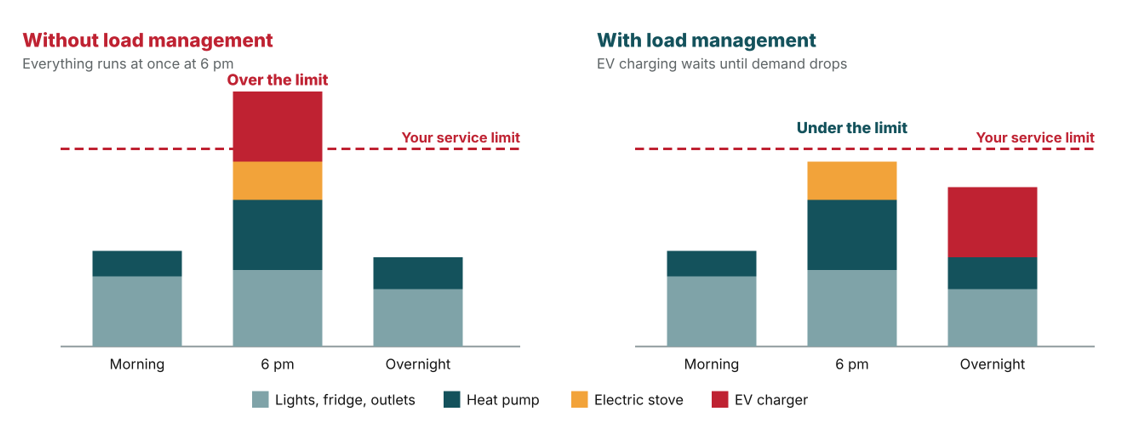
Load management devices watch your home’s total use and briefly reduce power to large loads, such as an EV charger, when other big appliances are running. They do not add capacity, but they can let you stay within your existing service. Scheduling big loads at different times, such as charging overnight, also helps.
|
Load management can work when… |
A full upgrade is likely needed when… |
|
You are adding one EV charger to a home with modest loads |
You are going fully electric: heat pump, EV and electric cooking on 100 amps |
|
EV charging can happen overnight while other loads are low |
Several large loads must run at full power at the same time |
|
An upgrade would be very costly or disruptive |
You have a Federal Pioneer, Zinsco or fuse panel that needs replacing anyway |
Load management devices: what to know
Examples: EV energy management systems such as the RVE (Thermolec) DCC series, Black Box energy managers and ABB’s residential system. Smart panels and breakers are also emerging. These are examples, not endorsements.
Are they allowed? For EV chargers, yes: the Canadian Electrical Code recognizes them, and a CSA standard (C22.2 No. 343) was published in 2025. For heat pumps and other loads, acceptance is newer and varies by province and territory.
Before you buy: confirm the device has a Canadian certification mark (CSA, cUL or ULC), ask a licensed electrician whether your provincial electrical safety authority accepts it for your use, and have it installed under a permit.
5 – The Upgrade Process and Timeline
|
Step |
What happens |
|
1. Assessment |
A licensed electrician checks your panel and does a load calculation. |
|
2. Permit |
An electrical permit is required in every province, usually obtained by the licensed electrical contractor. |
|
3. Utility booking |
The utility schedules a disconnect and may upgrade its own equipment. This is often the longest wait. |
|
4. The work |
With power off, the electrician installs the new panel, wiring, meter base and grounding (typically 4 to 8 hours). |
|
5. Inspection |
The provincial electrical safety authority inspects the work. |
|
6. Reconnection |
The utility restores power, sometimes with a new meter. |
|
7. Certificate |
Keep the inspection certificate. You will need it when you sell or make an insurance claim. |
How long does it take?
Plan for 2 to 6 weeks from permit to power restored, and longer in busy seasons or rural areas. This is why an emergency heat pump replacement often cannot include a panel upgrade within a fast-turnaround rebate. Plan ahead if you can.
6 – Hiring an Electrician
This is life-safety work. Choose on qualifications, not price.
Questions to ask
|
Topic |
Ask |
|
Need |
Will you do a load calculation and show me the results? Is load management an option for me? |
|
Future plans |
Will this upgrade cover a heat pump, EV charger, electric cooking or solar in the future? |
|
Permits and utility |
Will you get the permit and arrange inspection? What will the utility handle and charge, and how long will it take? |
|
Existing wiring |
Are there code problems or aluminum wiring that must be fixed as part of this job? |
|
Price and payment |
What is NOT included? Can final payment wait until the inspection passes? |
7 – Red Flags and Scams
Walk away if you hear or see any of these
What a good quote includes
8 – Costs and Rebates
Typical ranges (prices vary by region, home and utility):
|
Work |
Typical range |
|
100 to 200 amp upgrade: electrician (panel, service entrance, permit) |
$2,500 – $5,500 |
|
100 to 200 amp upgrade: utility-side charges (billed separately) |
$500 – $3,000 |
|
Panel replacement only (same amps, for safety) |
$2,000 – $4,500 |
|
Load management device (alternative to an upgrade) |
$400 – $1,000 |
|
New circuit for a heat pump or EV charger |
$300 – $800 each |
Save money and check rebates
Bundle the work. Adding heat pump and EV charger circuits during the panel upgrade costs far less than separate visits later.
Check rebates before you start. Some provincial and utility programs cover panel upgrades when needed for a heat pump or EV charger, and most require approval before work begins. Check official program websites, not a contractor’s word.
9 – After the Work
Helpful Resources
- Your provincial electrical safety authority (e.g. esasafe.com, technicalsafetybc.ca, rbq.gouv.qc.ca): verify licences and permits
- Your local utility: upgrade process, fees and timelines. nrcan.gc.ca and cacea.ca: find a registered Energy Advisor
We’re Here to Help
Want to Learn More?
Need Help Finding a Qualified EA?
CACEA™’s directory connects you with reliable, NRCan-registered EAs near you.
Want to better understand the importance of building science or the House-as-a-System?
Have questions about common terms used during your home assessment?
Questions? Contact info@cacea.ca